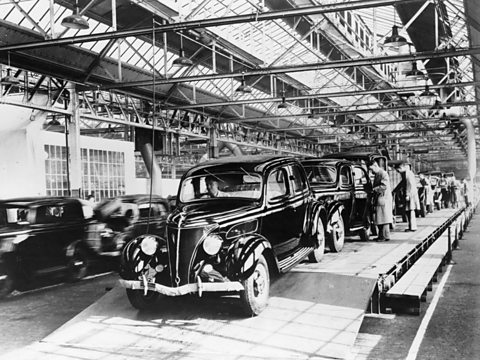
Growth of light industries in parts of Britain
A number of new light industries emerged in the 1930s. Many of these new industries were powered by electricity instead of coal, so they did not need to be built near coalfields. They could be built nearer areas of high population such as the Midlands and south-east England.
New consumer items and new employers
New goods came into production such as cars, radios, cookers and fridges. They were mass-produced in modern factories.
Clever advertising was used to encourage consumers to buy these items through the hire purchase scheme. This was even the case for the more expensive items.
The most purchased car, the Austin 7, could be bought for only £125 in 1936. This was £100 cheaper than in 1923. 2 million cars were sold in 1938.
By 1937 over half the households, even in the poorer areas of Wales, had a radio. More houses had mains electricity, so people were attracted to the new electrical consumer goods.
Major employers included car producers such as Ford of Dagenham, Hoover (vacuum cleaners) at Isleworth, west London and Cadbury at Bourneville, Birmingham.