Key points about ratio and fractions, and sharing in a ratio

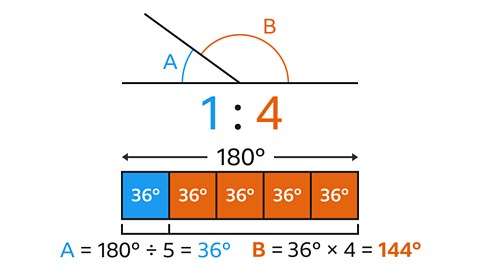
- A A ratio compares two or more quantities by using parts of a whole, eg a ratio of 1 : 5 means that for every 1 of the parts on the left, there are 5 of the parts on the right. shows the relationship between two or more parts.
- Each part of a ratio, eg 3 : 4, can be shown as a fraction of a whole.
- An amount can be shared in a ratio by finding the value of each part.
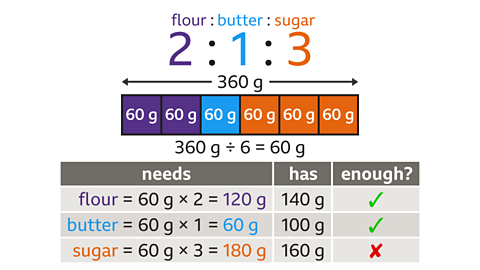
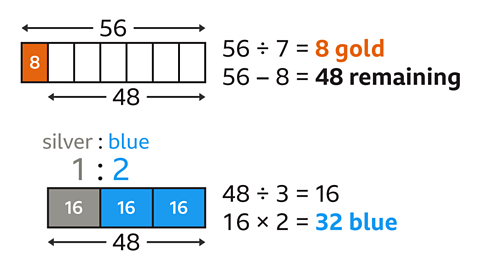
- A diagram using rectangles to visualise how an amount can be shared. diagrams are used to represent ratios and fractions visually in order to solve problems, such as dividing amounts in a given ratio.
To be confident with this topic, make sure you have an understanding of ratio and can calculate with fractions.
Video – Dividing into a given ratio
Watch this video to learn how to use bar models to divide amounts in a given ratio, with worked examples.
Dividing into a given ratio.
You can use bar models to divide amounts in a given ratio.
For example, Isabel and Geraint share their savings of £96 in the ratio 5 to 3.
How much money does each person get?
First, let's work out how many parts there are in total.
Isabel gets 5 parts and Geraint gets 3 parts. 5 add 3 equals 8 parts in total. This means the total amount, £96, is split into 8 parts. £96 divided by 8 equals £12, so each part represents £12.
Isabel will get 5 of these parts, so £12 multiplied by 5 equals £60.
And Geraint will get 3 of these parts, so £12 multiplied by 3 equals £36.
To check your answer, add the two shares. £60 add £36 equals £96, which is the correct total.
Let's try another question.
Malcolm, Jamal and Aoife are given £72.90. They agree to share it in the ratio 2 to 4 to 3. How much money does each person get?
This time, the money is being split between three people and the total number of parts is 2 add 4 add 3, which equals 9.
So, divide the total £72.90 by 9 to find that each part represents £8.10.
Malcolm gets 2 parts, so that's £8.10 multiplied by 2, which equals £16.20.
Jamal gets 4 parts, so that's £8.10 multiplied by 4, which equals £32.40.
And Aoife gets 3 parts, so that's £8.10 multiplied by 3, which equals £24.30.
To check your answer, add these values together.
This equals £72.90 which is the correct total.
Check your understanding
Ratio and fractions
A ratio shows the relationship between two or more parts.
A fraction shows the relationship between a part and the whole.

- The ratio of blue to orange parts is 2 : 3.
For every 2 blue parts, there are 3 orange. - The fraction that is blue is \(\frac{2}{5}\).
2 parts out of a total of 5 are blue. - The fraction that is orange is \(\frac{3}{5}\).
3 parts out of a total of 5 are orange.
To form fractions from a ratio, the part being referred to becomes the Number written at the top of a fraction. The numerator is the number of parts used, eg for ⅓, the numerator is 1., and the total of the parts becomes the Number written on the bottom of a fraction. The denominator is the number of equal parts, eg for ⅓, the denominator is 3..
Problem solving with ratios and fractions can also include percentages as another way of writing parts of a whole.

Remember
63% means 63 parts out of 100, which is \(\frac{63}{100}\) as a fraction.
Follow the working out below
GCSE exam-style questions

- The number of large to small lockers at a swimming pool is 5 : 1.
All the large lockers and a quarter of the small lockers are full.
What fraction of all the lockers are full?
Write your answer in simplest form.
\(\frac{7}{8}\)
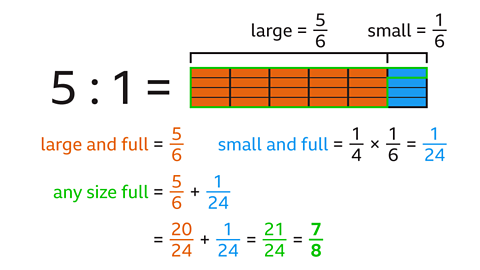
- Find the fraction of lockers that are each size.
There are 6 parts altogether in the ratio 5 : 1.
\(\frac{5}{6}\) are large and \(\frac{1}{6}\) are small. - Find the fraction of lockers that are small and full.
This is a quarter of \(\frac{1}{6}\). - Calculate \(\frac{1}{4}\) × \(\frac{1}{6}\) = \(\frac{1}{24}\).
- Add the fraction of large full lockers (\(\frac{5}{6}\)) and the fraction of small full lockers (\(\frac{1}{24}\)).
Make both the denominators equal to 24 by multiplying the top and bottom of \(\frac{5}{6}\) by 4.
\(\frac{5}{6}\) + \(\frac{1}{24}\) = \(\frac{20}{24}\) + \(\frac{1}{24}\) = \(\frac{21}{24}\) - Simplify\(\frac{21}{24}\) by dividing the numerator and denominator by 3.
The fraction of full lockers is \(\frac{7}{8}\).
- There are 10 times more right-handed students than left-handed students in a class.
What fraction of the class are left-handed?
\(\frac{1}{11}\)
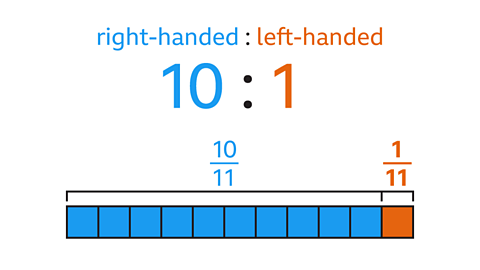
The ratio of right-handed to left-handed students is
10 : 1.
There are 10 + 1 = 11 parts in total.
1 out of 11 students is left-handed.
- A fruit salad contains apples and grapes in the ratio
2 : 3. The ratio of green grapes to red grapes is
1 : 3.
What percentage of all the fruit is green grapes?
15%
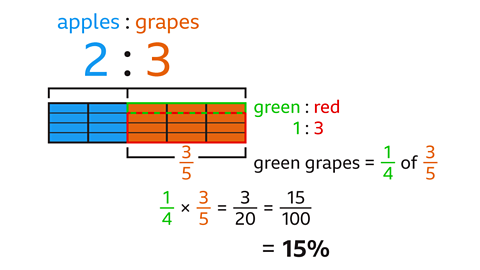
- From the ratio 2 : 3, the fraction of the salad that is grapes is \(\frac{3}{5}\).
- From the ratio 1 : 3, of all the grapes, the fraction that are green is \(\frac{1}{4}\).
The fraction of the salad that is green grapes is \(\frac{1}{4}\) of \(\frac{3}{5}\). - Multiply the two fractions to give \(\frac{3}{20}\).
- Convert to a percentage by finding an equivalent fraction with a denominator of 100.
Multiply the numerator and denominator by 5.
\(\frac{3}{20}\) is equivalent to \(\frac{15}{100}\), which is 15%.
Game - Ratio with other proportions
Complete this puzzle on ratio with other proportions from the Divided Islands game.