Key points about fractions

- A fraction is one way of showing parts of a whole.
- When fractions have the same Number written on the bottom of a fraction. The denominator is the number of equal parts, eg for ⅓, the denominator is 3., they can easily be put in size order.
- Every fraction has an Unlimited, goes on forever without end. Unable to be counted. An endless number. number of A fraction with the same value as another. Each fraction represents the same proportion, eg ½ and ¹⁰⁄₂₀. .
Support your understanding of this topic with these guides on simplifying fractions and writing equivalent fractions.
Check your understanding
How to simplify fractions and work out equivalent fractions
Follow the examples and working out below.
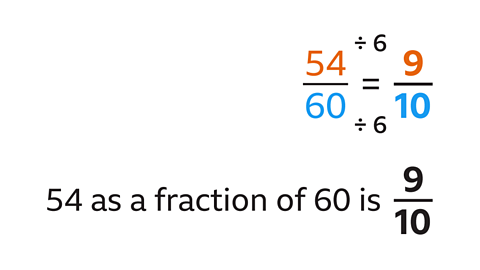
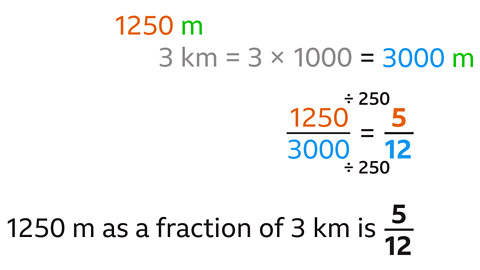
To To reduce a fraction to its simplest form, also known as its lowest terms. a fraction to its lowest terms, divide the Number written at the top of a fraction. The numerator is the number of parts used, eg for ⅓, the numerator is 1. and Number written on the bottom of a fraction. The denominator is the number of equal parts, eg for ⅓, the denominator is 3. :
- by their The greatest factor that will divide into the selected numbers. 10 is the highest common factor of 30 and 20.
or
- by A whole number which is a factor of two or more numbers. 2, 5 and 10 are common factors of 30 and 20. until their only common factor is 1.
To write an A fraction with the same value as another. Each fraction represents the same proportion, eg ½ and ¹⁰⁄₂₀. :
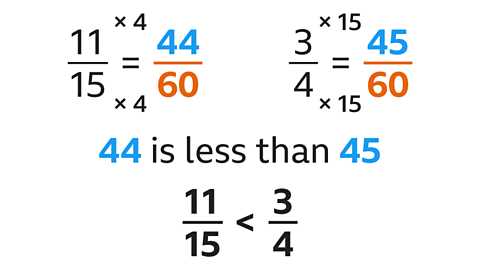
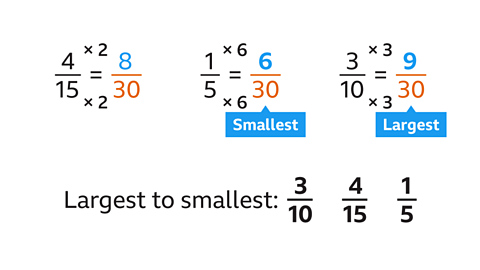
- multiply the numerator and the denominator by the same number
or
- divide the numerator and denominator by a common factor.
GCSE exam-style questions
- Which of the fractions are equivalent to \(\frac{12}{20}\) ?
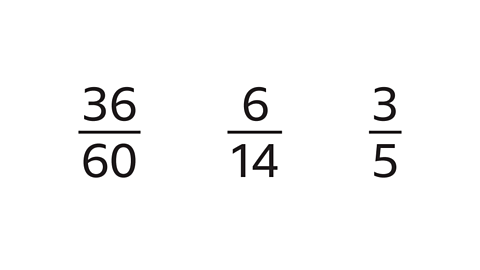
\(\frac{36}{60}\) and \(\frac{3}{5}\) are equivalent to \(\frac{12}{20}\) .
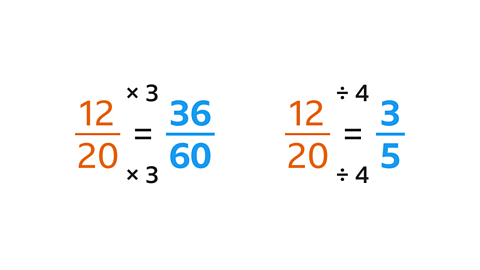
An equivalent fraction is the result of multiplying or dividing the numerator and the denominator of a fraction by the same amount.
- Multiplying the numerator (12) and the denominator (20) by 3 gives the fraction \(\frac{36}{60}\).
- Dividing the numerator (12) and the denominator (20) by 4 gives the fraction \(\frac{3}{5}\).
- Which fraction is \(\frac{15}{40}\) in its simplest form?
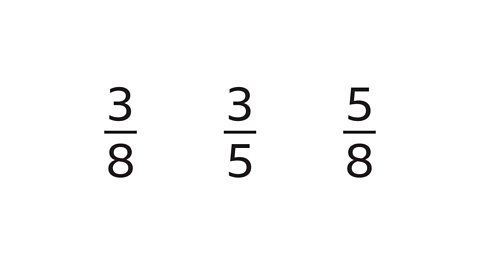
\(\frac{15}{40}\) in its simplest form is \(\frac{3}{8}\).
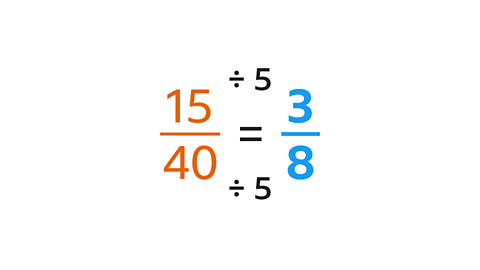
Divide the numerator (15) and the denominator (40) by the HCF of 15 and 40 (5).
15 ÷ 5 = 3 and 40 ÷ 5 = 8.
Game - Equivalent fractions
Complete these equivalent fractions puzzles from the Divided Islands maths game.