Key points
- Henry VIII had been a devout Catholic in his younger years. He had defended the Pope against the Protestant ideas published by Martin Luther, a German priest.
- In 1534, Henry declared that he, not the Pope, was the head of the Church in England. This sparked the English The Reformation (1533 – 1603) is the name given to the reform (changing) of the Church during the Tudor period..
- The break with Rome eventually triggered England’s transition to being a Protestant country.
- The Reformation had major repercussions, including the Dissolution of the Monasteries and many rebellions.
Video about the Reformation
Narrator:
Henry VIII was brought up as a devout Catholic. In the early years of his reign he attended mass five times a day and his most trusted adviser was the head of the Catholic Church in England, Cardinal Wolsey. So what caused Henry to break from the Catholic Church and its leader in Rome, the Pope?
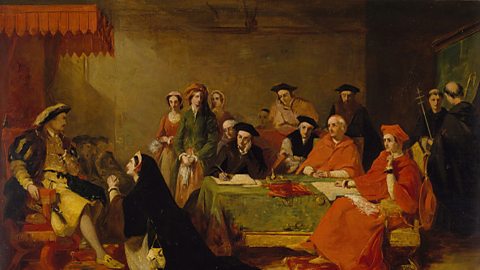
Henry and his first wife, Catherine of Aragon, had a daughter, Mary, but Henry wanted a son, a male heir to the throne. Henry had also fallen in love with Anne Boleyn. The Catholic Church would not allow Henry to divorce Catherine, so in 1527, he asked the Pope to annul the marriage instead. The Pope refused and Henry decided to make himself Head of the Church of England so he could marry Anne.
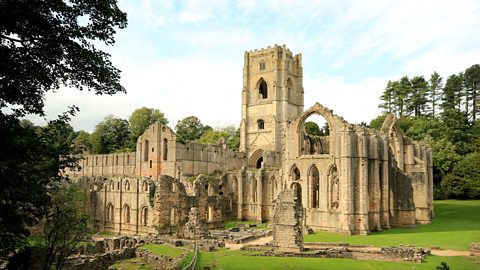
Another reason Henry wanted to break from the Pope was that the Catholic Church was very rich. By taking control of church properties, Henry would gain vast amounts of wealth that would help fund his wars with France, Scotland and Ireland. He and his new chief adviser, Thomas Cromwell, began the Dissolution of the Monasteries. Religious buildings were destroyed, and the land and wealth was transferred to the king.
Over four years, 800 monasteries were disbanded and their lands and treasures were taken by the Crown. At the same time, across Europe, a new religious belief system was emerging: Protestantism, led by people like John Calvin and Martin Luther. The Protestant religion rejected the Pope's control and wanted individual believers to have their own relationship with God rather than only through a priest.
These events came after many years of people calling for change within the Church. Even Anne Boleyn, who would become Henry's wife, was in favour of some church reform. The break with Rome opened the door for Protestantism to grow in the country.
This period is known as the English Reformation. Religious discrimination grew on both sides and after the reign of Henry VIII, the religion of the king or queen would play a vital role in the shape of the country for centuries to come. However, Henry VIII never became a Protestant.
This suggests his starting of the English Reformation was more about politics, wealth and family dynamics than his personal faith.
Game - Henry and the Catholic Church
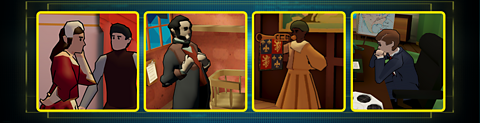
Play a History Detectives mission exploring why Henry split from the Catholic Church.