Political extremism and scheming 1929-1932
Not only did the Great Depression lead to an economic crisis, but it also led to a political one. There were three general elections between 1930 and 1932. The weak coalition governments in the The name of Germany's parliament. weren't able to deal effectively with the problems they faced and each one collapsed.
Hitler's appointment as Chancellor
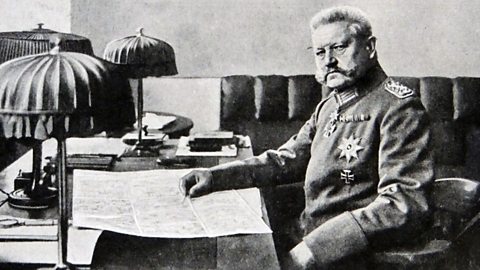
Central to the story that led to Hitler’s appointment as In the Weimar Republic, the Chancellor was the head of the government, appointed by the President. is the role of President Paul von Hindenburg. By 1932 President Hindenburg had to use The Chancellor could control without the Reichstag at a time of emergency. to pass almost every law.
1932
April - Presidential election. Hitler came second to Hindenburg, who won 53 per cent of the vote to Hitler’s 36.8 per cent.
May - Brüning’s government became very unpopular and he resigned. Hindenburg appointed Franz von Papen, a conservative, as his replacement.
July - Reichstag elections. The Nazis became the largest single party with 230 seats, but still did not have a majority. Hitler demanded to be made Chancellor but Papen remained.
November - Papen was forced to call another Reichstag election to try to win a majority in parliament. Nazis lost 34 seats but remained the largest party with 196 seats. Papen suggested abolishing the Weimar constitution. This led to Kurt von Schleicher, the Minister of Defence, persuading Hindenburg that if this happened there could be a civil war.
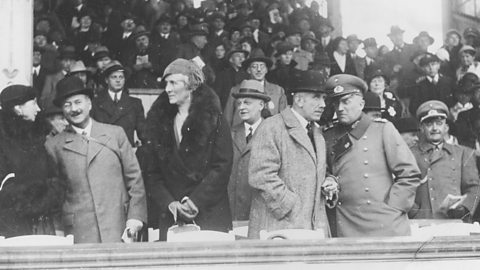
December - Having lost the confidence of Hindenburg, Papen resigned. Schleicher was then made Chancellor on 3 December 1932. Schleicher tried to split the Nazis by asking a leading Nazi called Gregor Strasser to be his Vice Chancellor. Hitler forced Strasser to decline.
1933
January - Papen agreed a deal with Hitler and persuaded Hindenburg to allow a Hitler/Papen government to be formed. Hitler was appointed as Chancellor of Germany after much political scheming on 30 January 1933 with Papen as Vice Chancellor. The Nazis had recently lost 34 seats and only 3 of the 11 cabinet posts were given to Nazis. Papen claimed that Hitler could be controlled as Chancellor.