Hormones used in reproductive technology to treat infertility – Higher
Some couples have difficulty conceiving children and this can be caused by a number of factors. The man might have a lower than average number of sperm in his semen, or the sperm may not be very mobile. Some women don’t produce enough FSH to allow their eggs to mature.
Fertility treatments
Fertility drugs contain Follicle Stimulating Hormone. It stimulates oestrogen production and the growth of follicles (egg-sacs) in the ovary. It is secreted by the pituitary gland., which stimulates eggs to mature in the ovaries. This treatment increases the woman’s chance of becoming pregnant, although the treatment may not always work. Because the treatment boosts the production of mature eggs, it increases the chance of twins or triplets. Multiple pregnancies carry a higher risk of complications, and may lead to premature or underweight babies.
In vitro fertilisation (IVF) treatment
If a couple are having difficulty conceiving a child because there are issues with the quality of the man's sperm, or a woman has blocked Also called a Fallopian tube or egg tube, this tube leads from an ovary to the uterus., then in vitro fertilisation or The letters stand for 'in vitro fertilisation'. This involves bringing the sperm and the egg together to create an embryo, which is placed into the woman's womb to increase the chance of giving birth. can be used.
- IVF involves giving a mother FSH and LH to stimulate the maturation of several eggs.
- The eggs are collected from the mother and fertilised by sperm from the father in a dish in the laboratory (in vitro literally means 'in glass').
- The fertilised eggs develop into An organism in the early stages of development..
- At the stage when they are tiny balls of cells, one or two embryos are inserted into the mother's Also known as a womb. This is where the fertilised egg (ovum) develops..
The development of microscopy techniques has allowed IVF treatments to be developed further.
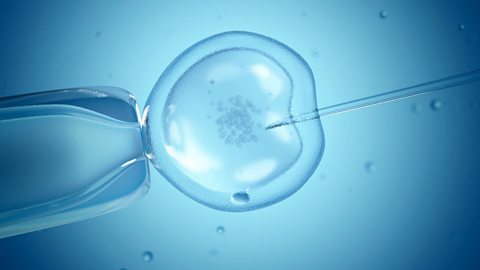
In some cases, the sperm have difficulty moving so cannot fertilise the egg. Scientists can now directly inject the egg with a sperm cell. They use a powerful light microscope to carry out this technique.