A long time ago, in a galaxy far, far away
It's now been nearly 50 years since Star Wars burst onto the scene and quickly became a cultural phenomenon. Created by George Lucas, the American space fantasy film series is centred around the theme of good and evil, as well as the Skywalker family's multi-generational battle against the Galactic Empire and Sith Lords.
But a 'long time ago, in a galaxy far, far away,' the Star Wars franchise entered a period of civil war with the laws of physics. Sci-fi films do like having a bit of fun with the fundamental aspects of our universe.
But is there anything they get right? Here, BBC Bitesize takes a closer look.
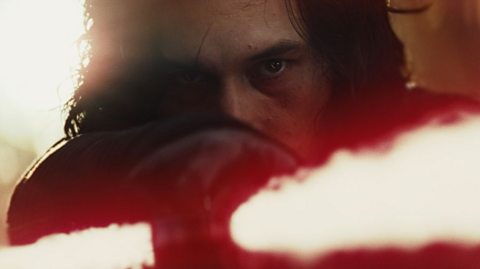
4D cinema
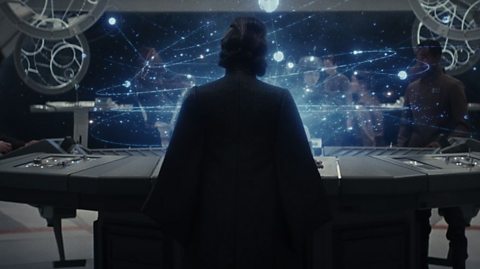
One thing that George Lucas may have been on the right track about, according to some scientists, is hyperspace - a ‘4th dimension’ that allows you to travel to places really far away faster than the speed of light. In the movies, this is done by activating a spaceship’s ‘hyperdrive.’
That in itself seems impossible, as light travels faster than anything else in the known universe. But some theories have suggested that ‘wormholes’ - essentially tunnels between two points in space - could get around this.
One way of imagining them would be with a piece of paper, with you on one side, and where you want to be on the other. As it currently stands, to get from A to B, you’d have to travel all the way up your side of the paper and then back down the other.
But if you fold it in half and poke a hole through, you then have a tunnel that gets you there much faster. This is (roughly) how wormholes are thought to work, and could explain how Han Solo and the gang get across the universe so quickly.
A weapon proton-type
There are other things in Tatooine and beyond that are loosely based on real science. One example of this is the ‘proton torpedo’ that is used to penetrate the Death Star’s shields and eventually destroy it in 'A New Hope.'
These extremely powerful proton beams may not have been developed to destroy spaceships yet, but we do use something similar to destroy tumours. One form of cancer therapy uses beams of protons to target tumours in hard to reach parts of the body. They can trace around the growths with extreme precision, making it an effective way of treating more complex cancers.
Relight my fire
So there are parts of the Star Wars universe that are somewhat rooted in fact. But don’t worry, there’s plenty that it gets wrong, too.
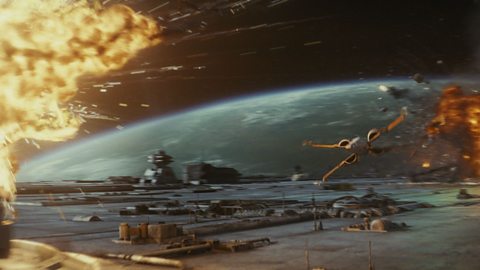
One classic trope used in pretty much every sci-fi film is a huge explosion in space. During opening battle sequences in Star Wars, it’s not uncommon to see lasers flying here, there and everywhere, and a spaceship going up in flames when hit.
However, it’s quite hard for a big ball of fire to be created in an environment with little to no oxygen, given it needs oxygen to sustain itself. In reality, any such explosions would be a lot smaller, and quickly sucked into a vacuum.
These battle scenes and the explosions that are such a staple of them are also really noisy on-screen. In real-life, however, they’d be very quiet, as sound can’t travel if there’s no air.
There is a light(saber) - and it never goes out
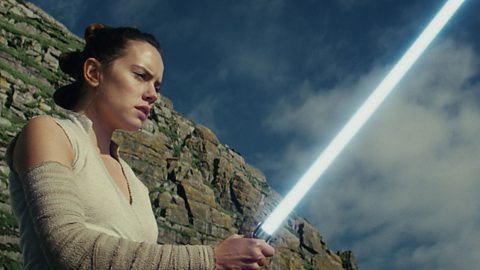
One thing in particular that has fascinated fans and scientists alike is the lightsaber. There are different theories about whether or not the weapons powered by the Force are possible - only a Sith deals in absolutes.
Taking the name literally, some people think that they’re meant to be made of lightor, more accurately, lasers. The problem with this is though, is that the laser beam wouldn’t ‘stop’ - that is to say, light carries on travelling until something obstructs it, so in theory lightsabers could be ten feet long, to a hundred feet long, depending on the Jedi’s surroundings. Also, as you know if you’ve ever teased a cat with a laser, you can’t touch them, so they wouldn’t be able to inflict much damage.
Others though think they could potentially be made out of other substances, such as super-charged plasma. Plasma is the fourth known state of matter in the universe, after gasses, liquids and solids. They’re made up of electrically charged particles, and therefore have a magnetic field, so in theory could be fashioned into a blade using magnets.
However, if and when a Jedi fights a Sith, these magnetic fields would be disrupted, so instead of a really cool battle, you’d just be instantly covered in plasma soup, and probably hurt yourself as much as you’d hurt your opponent.
Scientists at MIT and Harvard in the States actually tried to make a lightsaber, or at least create the substance one could be made out of. They did this by combining photons to create a ‘photonic molecule’ which behaves as though it has mass, but also has similar properties to light. This substance hasn’t been fashioned into a sword yet though.
Clearly then, it’ll be a long time before we can start jumping through hyperspace to defeat Kylo Ren some place across the galaxy. But silly insignificant details such as the laws of physics won’t get in the way of the Jedi and the Sith.
How many Star Wars films are there?
The first film in the space opera saga began in 1977 and from there many sequels, prequels and spin-offs have been released. In total, there are 11 live action Star Wars films, one major animated film and several TV spin-offs, such as The Mandalorian, Ahsoka, and The Book of Boba Fett.
What order do you watch the Star Wars movies in?
It's been at the centre of much debate by thousands of fans. But what order should you watch the franchise in?
Well, for the classic experience, you can watch the films in release order as generations have. But to understand the evolving timeline of Star Wars, you should generally watch them in chronological order.
For release order, the first film is Star Wars: A New Hope was in 1977. However, the first chronological Star Wars film is Star Wars: Episode I: The Phantom Menace (1999).
When is The Mandalorian & Grogu film released?
It was back in 2019 that Star Wars fans were first introduced to Disney+ spin-off series The Mandalorian. The show follows lone bounty hunter Din Djarin who protects a Force-sensitive child, Grogu - often nicknamed 'Baby Yoda' by fans.
Following on from the series, The Mandalorian & Grogu film is set to be released in UK theatres on May 22, 2026. Directed by Jon Favreau, the live-action Star Wars film will see Pedro Pascal reprise his role as Din Djarin, the titular character in The Mandalorian.
What does 'May the fourth be with you' mean?
If you're a Star Wars fan, you'll likely have heard the famous film catchphrase 'May the Force be with you.' But every year, Star Wars Day is celebrated globally on 4 May, as the date lends itself to the pun 'May the Fourth be with you.'
The popular holiday sees fans across the world do everything from wear costumes inspired by their favourite characters to attend events and screenings of the loved franchise. In 2026, 4 May is on a Monday.
This article was published in May 2019 and updated in April 2026