Meet Lee, who's a HEMS (Helicopter Emergency Medical Service) pilot for North West Air Ambulance. Part of our Bitesize world of work series.
Lee
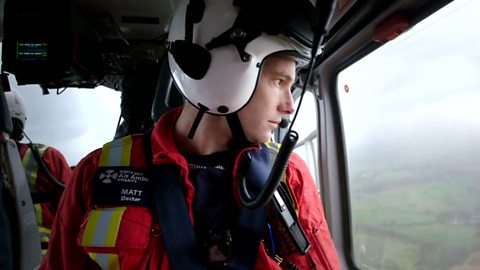
I'm Lee, I'm 47, and I'm a HEMS pilot for the North West Air Ambulance. So the role of the HEMS pilot is to provide a quick form of transport for the paramedics and doctors to the scene of an incident as fast as we can. So the patient who's involved, sometimes in a really serious accident, can get specialist care in a very short space of time.
We do very little planning, so a call comes in and we just have to launch. The speed at which we can get to them makes a big difference in the treatment of these people. The challenges when we get to an incident are finding a site which is big enough, which is safe enough. If we're landing urban, next to people's houses, they can damage fences and blow over gazebos in gardens, so we have to be considerate to all these factors. But the biggest one is the safety of people on the ground and in the aircraft.
Simon
I have great confidence in Lee and his pilot abilities. Lee can land in a very small space and get us close to a patient really quickly, which is really important when it comes to life or death situations. We're a really close-knit team on HEMS – we work really closely together and Lee is a really big and important part of that team.
Lee
So, on a morning, we do a brief to make sure that the day is going to be good for flying. "There's no restricted airspace or anything that's going to stop us going anywhere. If we do go urban, good lookout for wires, cranes, drones, kites. If you see anything you're not happy with, shout – doesn't matter where it is in the profile, if you've seen it make sure I see it."
The first time I went in the helicopter as a passenger, I knew that it was a career that I wanted to pursue. It's such a satisfying job seeing the crews working at the scene to help save somebody's life.
There are two ways that you can learn to become a pilot. One is the civilian route, where you do your private pilot's licence and then your commercial pilot's licence. The second route is through one of the Armed Forces – either the Army, the Navy or the Air Force. You need a lot of determination to achieve the qualifications. It is expensive, but anybody can achieve it if they really want to and they have the determination. It is an amazing career.
The first time I went in the helicopter as a passenger, I knew that it was a career I wanted to pursue.
- Lee's job is to provide a quick mode of transport for medics to get to emergency call-outs. The helicopter can save precious time in reaching a patient, giving them a better chance of a positive outcome
- From the first time he went in a helicopter as a passenger, Lee knew that being a pilot was the career he wanted
- One of the biggest challenges is finding areas that are big and safe enough to land the helicopter to get the medics as close to the patient as possible
- Becoming a pilot is a challenging path but Lee believes it is possible if you have the determination.