At stressful times like this, it’s important to manage your own wellbeing, as well as your child’s. BBC Bitesize Parents’ Toolkit has been getting some advice from Sue Armstrong, clinical service manager at relationship support charity Relate, and Beatrice – not her real name – whose eldest child is autistic and has been off school with EBSA.
What is emotionally-based school avoidance?
Emotionally-based school avoidance (EBSA) is when a child is regularly absent from school, or cannot attend at all, due to anxiety or other emotional or physical distress. EBSA was often previously referred to as ‘school refusal’ but many parents feel that term has negative connotations. For a parent EBSA can mean worrying about your child, juggling work with caring responsibilities whilst your child is at home, and also managing your other relationships and commitments.
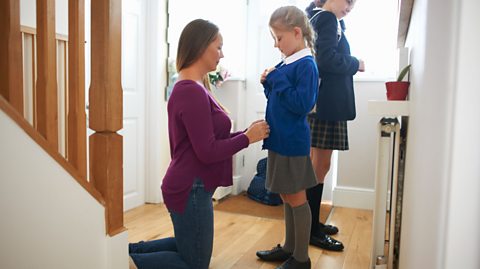
6 tips to protect your mental health whilst still supporting your child with EBSA
Tip 1: Talk to those that know
Beatrice's daughter is now 12 years old and she struggled to attend school over a two-year period: “I had to quit my job and I was permanently exhausted and had zero time to myself. Trying and failing day after day, every single morning, to enable my child to attend what should be a normal school day, trying to then work from home with high anxiety and phoning anyone who would listen to ask for help when they didn't know what to say… The only thing that got me through was meeting other parents who were going through the same thing, and finding a sense of humour with them.”
“Talking to other people who 'get it' is really important.”
Sue Armstrong from Relate agrees. She advises that you to talk to trusted friends alongside speaking to other parents “who have been or are going through a similar experience”.
Beatrice says you can find a wealth of information online, and recommends websites like Autistic Girls Network, who have peer support groups in some areas, Not Fine in School, National Autistic Society and ADHD Foundation, who offer family workshops.
Tip 2: Avoid blaming yourself and your child
Sue says it’s also important to try not to feel guilty or that your child’s EBSA is somehow your fault: “There are often several factors in a child’s life that lead to them developing EBSA… Most parents will focus on trying to help their child come through this difficult period and it can feel overwhelming.”
Beatrice adds: “It is not your fault – remember this at all costs. You will get angry and you will need to vent. There are always allies. Reach out to get information, advice and support, to any professionals available, to get any support you can to figure out a personalised approach for your child and family.”
“Please ask for help and do not blame yourself or your child.”

Tip 3: Keep communicating as best you can
Whatever your family set-up, it’s important to communicate about what’s going on as much as possible. Sue says: “In some situations, parents may have different views… which could then cause additional stress, and sometimes disagreement between them.” If this is you, then it’s important to discuss these issues with your partner. If that is proving difficult, then you can reach out to charities like Relate for additional support, or read their guide to better communication.
“With any family situation, making time to talk together is vital.”
If you’re separated or a single parent, Sue advises communicating with your child’s other parent where you can, or asking other family members for practical and emotional support. If your child’s other parent doesn’t live nearby, maybe they can offer support in the form of a daily phone call to your child, or you can temporarily change contact arrangements with your other children, to give you space to focus on your child with EBSA.

Tip 4: Look forward to positive things
Sue says: “Any issue affecting the wellbeing of one’s children can feel overwhelming at times, so that having good times can get pushed out. Continuing ‘normal’ family events will help all of you. Finding time, when you can, for your own interests, as a couple and individually, is [also] vital so you don’t feel swamped.” Calling on other family members or friends to care for your child so you can have a small amount of time out will help everyone in the long run.
Beatrice adds: “Rest when you can and try not to catastrophise about worst-case scenarios. In most cases it does get better. It might get better because you find a better fit of educational provision. It might get better when your child is able to attend incrementally (for example for three hours a day). I can't tell you how it will get better but I can tell you that you absolutely have to try and find some way to look after yourself in order to relax and keep your strength up.”
These six self-care tips for parents may help.
“Try and plan some fun times together, as a family, and as a couple.”