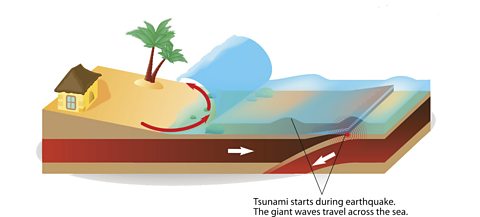
For 200 years, the tectonic plates under the Indian Ocean have been pushing against each other, bending the upper plate down like a giant spring. On the 26 December 2004, 20 miles below the ocean's surface, the forces reached breaking point. The fault starts to rupture. The western side of the mountain range on the edge of the plate is thrust up by as much as 40 feet.
At twice the speed of a bullet, the plates unzip over a distance of more than 750 miles, lifting the seabed - and the entire ocean above.
On the surface, the displaced water moves out as a series of giant ripples. This is a tsunami. Just a metre high, but a hundred miles from front to back, the tsunami is billions of tons of water travelling at over 500 mph.
From land, the first sign that something is wrong appears as the sea begins to pull back. This is the trough of the wave reaching land. The tsunami now goes through a terrifying transformation.
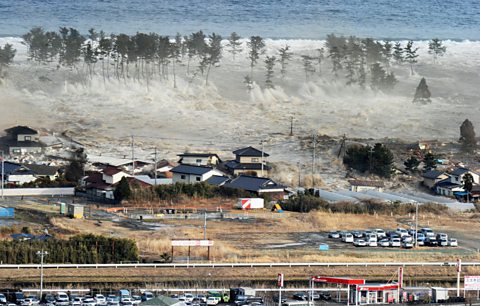
As it nears land, the shallow water slows the wave dramatically. But the back, a hundred miles behind, is still travelling fast. Now, it catches up, compressing the wave into a vertical wall of water up to 115 feet high.
It hits Banda Aceh with the force of sixty hurricanes, destroying everything in its path. 45 minutes later, at 9.30, a 60-foot wave crashes into Thailand. 30 minutes on, it engulfs the island of Phi Phi.
At the same time, on the other side of the ocean, the wave travelling west hits Sri Lanka. The tsunami's energy is so great, it travels around the world three times.