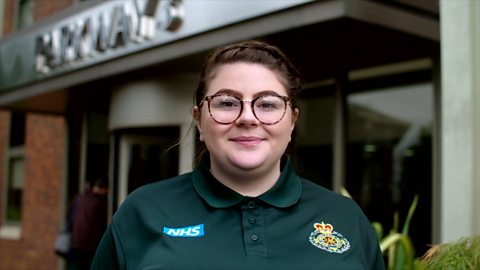
Meet Dilan, 25, from Birmingham. He is a community midwife in Lewisham, south London.
Part of our Bitesize world of work series.
The best thing about my job is it's fulfilling and exciting.

Meet Dilan, 25, from Birmingham. He is a community midwife in Lewisham, south London.
Part of our Bitesize world of work series.
The best thing about my job is it's fulfilling and exciting.
Hi, my name's Dilan and I'm a community midwife.
Dilan:
Baby's heart rate sounds nice and normal.
Patient:
It's nice to hear her because it gives me reassurance that she's actually alright.
Dilan:
A community midwife works to provide care from the start of pregnancy until after the birth. We work on call for home births, rather than at the hospital.
(on the phone) Hello, it's midwife Dilan.
One day a week I run a clinic for my caseload of people who I see throughout their pregnancy, and up to a month after their birth. My other days in the week and sometimes nights are spent being on call for clients who are requesting a home birth.
The best thing about my job is it's fulfilling, it's exciting. When you get a call from someone in labour, you have to get into that ‘go time’ mindset, and you get loads of support from everyone around you when that happens.
Recently staffing has been a big challenge, while maternity teams often work really well to ensure we can deliver safe care, it has been tough given the national shortage of midwives.
So, you're happy for us to have a check on baby?
Patient:
Yeah that's fine.
Dilan:
Alright, I'll just lay the tissue paper.
So me, I came across midwifery in a university prospectus, just before my GCSEs. What started out as a joke turned into a conversation with the pastoral support teacher at my school, she thought this was an entirely realistic career path, she said "you know what Dilan, you should think about midwifery".
After I did my exams, I wanted to get a bit of experience over the summer holidays, and so as part of that, I joined the voluntary services at the Birmingham Women's Hospital. I was doing surveys with the service users, helping our admin staff and just learning a lot more about what it's like to be in a women's health focused environment.
I took A-level Psychology, Politics, Biology and Chemistry. I remember finding Chemistry very challenging so I dropped it afterAS-level, but the rest of my subjects gave me a really good foundation, which meant I could go on to study Midwifery at King's College London.
(to patient) So I'm just going to feel for the baby's position alright, if there's any tender spots or anything like that just let me know, yeah?
Midwifery work is something that will exist as long as people are having babies, and that was a big reason as to why I even applied for a course, it does have good job security. I think my voluntary work gave me a really good opportunity to interact with people and gain their trust, which is a vital skill for a midwife.
I remember thinking to myself that it was a good test of my communication skills, even down to simple things like when you meet new people in the staff room, trying to say hello within the first ten seconds.
You have to be extremely organised, your clients rely on you for their care, so you also have to be capable of being very flexible as you may have to attend a birth within an hour of receiving a call, literally out of the blue.
I do wish I'd known there would be so much placement work on my course, I wasn't really prepared for how intense it would be, and you can often feel a lot of pressure to be practising like a fully fledged midwife from very early on in the process. Even though you are working under the supervision of a qualified midwife, I think it's just important to be patient with yourself.
(to the patient) So yeah, I mean I completely agree with you…
It is important to take the opportunity just to see what it's like. Doing voluntary work gave me that chance to speak with service users, to get your foot in the door on volunteering opportunities or anything that just allows you, not only to be in a care environment, but to get closer to women's health.
I think it's important to be honest with yourself and the volunteering team about how much time you're willing to give even if it's a couple of hours a week.

You could get into this role via a university degree, an apprenticeship or a specialist course run by a professional body.
Sources: National Careers Service, NHS Health Careers
This information is a guide and is constantly changing. Please check the National Careers Service website and the NHS Health Careers website for the latest information and all the qualifications needed.
For careers advice in all parts of the UK visit: National Careers Service (England), nidirect (Northern Ireland), My World of Work (Scotland) and Careers Wales (Wales).

The Open University and BBC have been working in partnership for over half a century to provide a unique public service offer covering all four nations of the UK. Each year the OU co-produces a wide range of content for television, audio – radio and Sounds, digital and social with the BBC, including BBC Bitesize.