Key points about one- and two-step linear equations

- Solving an A mathematical statement showing that two expressions are equal. The expressions are linked with the symbol =. means finding the value of an unknown A quantity that can take on a range of values, often represented by a letter, eg 𝑛, 𝑥, 𝑦, 𝑧, 𝑡 … etc. so that the equation is true.
- Equations are solved by using The opposite of a mathematical process. For example, the inverse of × 5 is ÷ 5. The inverse operation undoes the original process. .
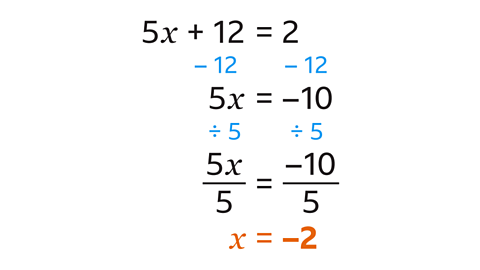
- Equations such as 𝑥 – 5 = 12 need one step to solve. Equations such as 3𝑥 + 8 = 15 need two steps.
Make sure you are confident in calculating with negative numbers, which is a skill often needed to solve equations.
Check your understanding
Solving equations with one step
An equation is a mathematical statement showing that two A mathematical sentence made up of one or more terms expressed either numerically or symbolically. are equal. It includes an equals (=) sign, and an unknown An unknown value, usually represented by a letter such as 𝒙 or 𝒚., usually the letter 𝑥.
Solving an equation is the process of working out the value of 𝑥.
To solve an equation, The opposite of a mathematical process, eg, the inverse of × 5 is ÷ 5. The inverse operation undoes the original process. are performed on both sides until the value for 𝑥 is known.
The simplest equations have just one inverse operation to perform.
Follow the working out below
Exam style questions
- Solve 𝑤 – 8 = –2.
𝑤 = 6
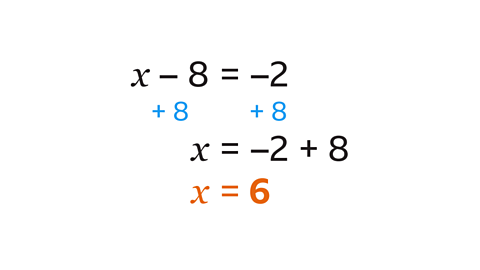
To solve the equation, do the inverse operation. The inverse of subtracting 8 is adding 8. Adding 8 to both sides gives the solution 𝑤 = 6.
- Solve 12𝑑 = 3.
𝑑 = \(\frac{1}{4}\)
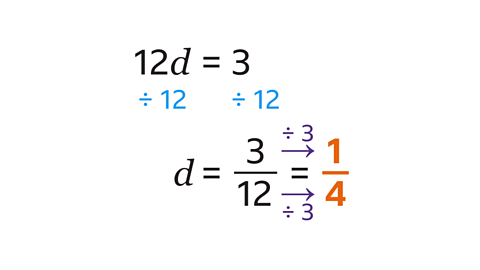
To solve the equation, do the inverse operation. The inverse of multiplying by 12 is dividing by 12. A fraction line can be used to show ‘divide by’. Simplify the fraction by dividing the numerator and denominator by 3.
Game - One step equations
Practise your solving one step equation skills with these questions from our Divided Islands maths game.